
Who was the first laughing stock in history?
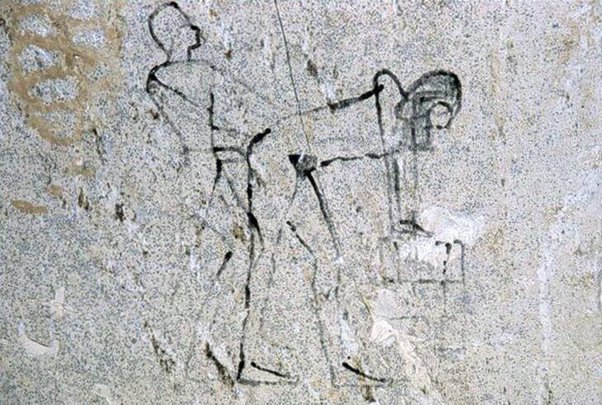
My answer is inspired by a lewd cartoon carved on a wall some 3,500 years ago in the uncompleted hall of a chapel commissioned by Hatshepsut (1507–1458 BC) near her temple of Deir el-Bahri.
(Voronin, P., 2015):
The carving is politically satirical in nature and is believed to be a scurrilous caricature of Hatshepsut and her close advisor, Senenmut, making love doggy style. The female ruler of Egypt had deposed her nephew, the future Thutmose III, heir to the throne but too young to rule, and assumed the royal regalia of a male king, including the double crown and the false beard, in order to legitimise her right to the throne. Her accomplishments were notable, including opening up trade routes and bringing back great riches, such as incense, myrrh, ivory and gold, from the fabled land of Punt. The enormous memorial temple at Deir el-Bahri, one of the architectural wonders of ancient Egypt, was designed and implemented by her royal steward Senenmut.
There is much speculation as to whether Senenmut and Hatshepsut were lovers. From humble beginnings, Senenmut attained the pinnacle of political stardom with over 90 titles and intimate privileges. It is possible that he might have been envied and even hated. The royal subjects might also have been unhappy with their unconventional female ruler, fearing that this usurpation might upset the balance of Ma’at.
The naughty graffito suggests that a workman wanted to put his female boss in her place as well as make a statement about how everyone knew or suspected what was going on in the royal bedchamber. There must have been some uproarious laughter and lewd comments echoing throughout that chapel.
Late in his reign, her successor Thutmose III had almost all of the evidence of Hatshepsut’s rule eradicated. However, many statues, paintings and carvings have survived, including this titillating little cartoon.
Cooney, K. M. (2014). “The Woman Who Would Be King: Hatshepsut’s Rise to Power in Ancient Egypt”. Crown Publishing