
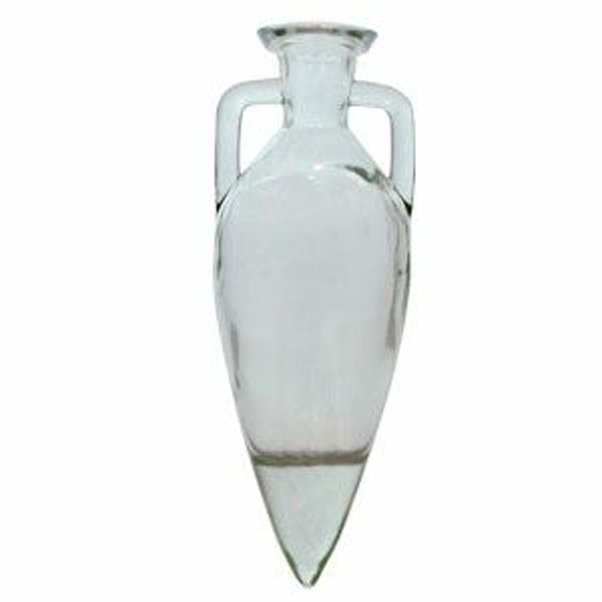
It was a gorgeous and remarkably efficient design.
Amphorae were mostly used for transportation of liquids. Being made of pottery, they were brittle and subject to cracking and breaking when roughly handled.
Flat-bottomed jugs have an edge where the bottom meets the wall of the jar. This is a weak spot subject to damage if dropped or bumped too hard. Many jars were broken before shippers learned that a narrow, but very thick bottom with no weak edges was subject to less breakage.
The long dual handles enabled stevedores to pass them from hand to hand easily when loading ships. They provided lashing points when they were stowed or being swung aboard with ropes. The handles also prevented amphorae from rolling when lying on their sides.

The pointed bottoms allowed a heavy amphora to be dragged. They allowed the ship to fit more in the cargo hold by placing the point between the necks, reducing the empty space. The tight fit helped prevent the shifting of cargo in rolling seas.
Finally, the amphora was cheap to make. The transport versions were not normally reused. It was cheaper to make new ones than to transport empty amphorae back to the source. Large mounds of broken amphorae have been discovered at many ancient Mediterranean ports.
EDIT: No, amphorae did not have pointed bottoms so that they could be stuck upright in the sand. Not only was there no reason to do this (it was a shipping container) but Amphorae are very top-heavy and fragile. You would have to dig a hole and bury it deeply to keep it from falling over. Then how would you pour it out?