
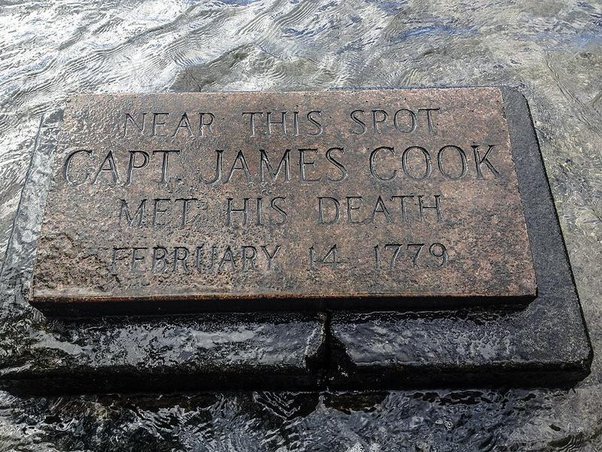
You’ve probably heard of James Cook. He was one of the best known British sea captains of the 18th century, traveling everywhere from the Bering Straights to Australia and Antarctica. He is best known, however, as being the first European to explore the Hawaiian Islands. I bet he wished he had never made that discovery.
At the age of 40, Cook was given command of the H.M.S. Endeavour on which he sailed members of the Royal Society around the world. In January of 1778, the Endeavour happened upon what we now know as the Hawaiian Islands.
The ship spent months sailing from island to island, replenishing their supplies and recording what they saw. Cook sailed into Kealakekua Bay while the residents there were having a large festival. The locals felt the men were gods because they had a legend that the Hawaiian deity Lono would appear to them in a similar way.
The crew of Endeavour never set the locals straight and felt free to enjoy all of the niceties that might be afforded to a god. Unfortunately, one of Cook’s men fell ill and died, thus proving them mortal. They had a lot of explaining to do, and the natives weren’t buying it.
An angry mob began pelting the crew with rocks, things got out of hand, and the chief of the local population was shot dead. Everything fell apart after that; the explorers were systematically killed.
Captain Cook was stabbed in the neck and died on the beach. The natives took his body back to their village, boiled his corpse, and scraped the meat from his bones. Contrary to popular belief, Cook was not cannibalized.
The Hawaiians believed that a person’s spirit and power resided in their bones. Boiling the body and stripping the flesh was simply the most efficient means of getting to those bones. The islanders must have felt that Cook was somewhat godly as they treated his remains with great reverence before burying them at sea in Kealakekua Bay.