
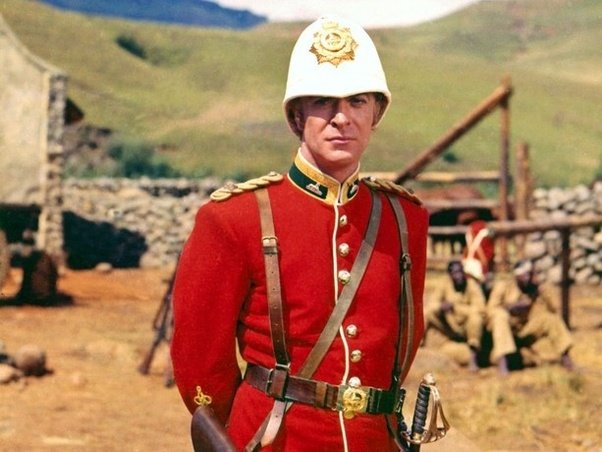
Michael Caine was not the original choice for the role of Lieutenant Gonville Bromhead in the film Zulu because his Cockney accent didn’t fit the role of an officer and a gentleman.
But he looked the part, didn’t he?
When the film Zulu went into production, the South African weather was not kind; it rained, causing serious delays, but the producers insisted that the actors and entire crew rehearse, which allowed Michael Caine time to become an officer. He played it perfectly, which made him an international star. He originally auditioned for the role of Henry Hook.
James Booth played Private Henry Hook and was the only cast member not to go on location to film, because all his hospital scenes were filmed at Twickenham Film Studios in England.
Welsh baritone singer and actor Ivor Emmanuel, who played the role of Private Owen, leads the British soldiers in a rousing rendition of the battle hymn “Men of Harlech” to counter the Zulu war chants in one of the film’s most memorable scenes; later on, he said being part of Zulu was the highlight of his career.
Well, they’ve got a very good bass section, mind, but no top tenors, that’s for sure.
Private Owen, Ivor Emmanuel (left), with Lieutenant John Chard, Stanley Baker.
Zulu was Stanley Baker’s labour of love, and he worked tirelessly to secure the financing and a good director. However, the production crew faced a serious problem in sourcing enough Martini-Henry rifles and the necessary amount of blank ammunition for the film. They enquired with the British War Department about hiring some Lee-Enfields, blank ammunition, and soldiers as extras. Obviously, someone at the War Office liked the script, so they obliged, and the British soldiers were borrowed from Kenya.
Every actor in this final scene is firing the Lee Enfield (1898) without the magazine attached.
In 1972, Baker purchased a collection of medals belonging to the real John Chard from an auction for £2,700. Included was a Victoria Cross, but in the auction catalogue, it was described as a “cast copy”, with an estimated value of only £15. Believing it to be a replica, Stanley Baker allegedly “threw it into a drawer and forgot about it.” When Baker died, his widow sold the collection for £5,000. In the 1990s, the owner decided to get the fake VC tested; it wasn’t fake after all, and he sold it to Lord Ashcroft for £250,000.
Lord Ashcroft buys Victoria Cross medals and holds the largest collection in the world, and owns two from the Battle of Rorke’s Drift.