
Yes, of course it can. This has happened over and over again in history.
But remember history doesn’t repeat itself. It rhymes.
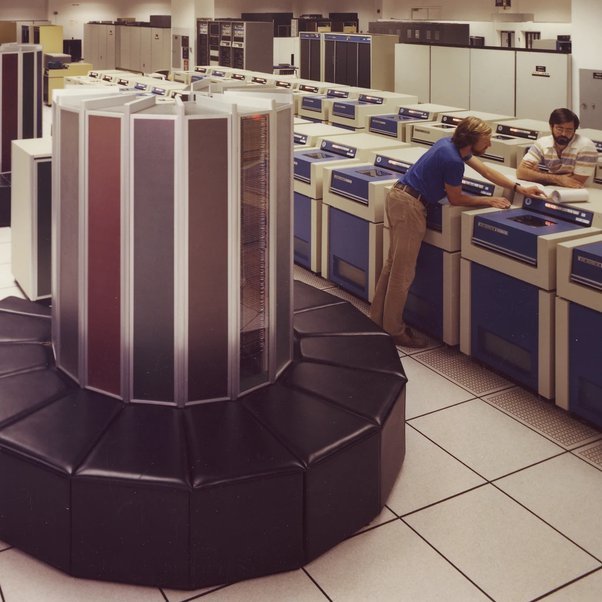
Here’s a picture of the original super computer, Cray-1.
Released in the 1970s, It only had a few megabytes of computing power and one 64-bit processor. It couldn’t even open a single app on my smartphone today.
Hard to believe this was only 50 years ago.
And it would cost over $33 million to make today. When compared to my thousand-dollar smartphone, the cost savings are significant.
So what’s the point?
Over a long period of time, combined with lots of manpower and resources, we see significant increases in technology.
For comparison let’s look at the Apollo missions.
Started in 1961, the Apollo missions developed a guidance system without a supercomputer. It was designed to navigate a rocket ship to the Moon. Sounds like sophisticated stuff but did not require a supercomputer. The entire machine was powered with 74 KB ROM and 4 KB RAM memory, or the equivalence of a Commodore 64 (who remembers those??).
Again this guidance system doesn’t have enough memory to even power one app on my smartphone.
Yet it took mankind to the moon.
So yes supercomputers will be miniaturized. It takes time and energy.
The real question is where will computing power be most effective? If we didn’t need it to go to the Moon then where will supercomputers be most useful?
I think we have enough technology resources today to travel the entire solar system. We just need more smart people working on the hardest problems to maximize our computing power.
There is a lot more at our fingertips than you believe.